IRONMAN® vs IRONMAN® 70.3®: Comparing race nutrition strategies
PF&H Sports Scientist Emily Arrell compares the race nutrition strategies of IRONMAN® and IM 70.3® athletes to see how a change in distance impacts fueling approaches...
By Emily Arrell
5 Minute Read
Ahead of the 2023 IRONMAN 70.3 and IRONMAN World Championships, I compared the race nutrition strategies of triathletes racing over 70.3 and 140.6 miles for an edition of the PF&H newsletter.
I crunched the numbers from 137 Athlete Case Studies to see how a change in distance affects their fueling strategy.
I've shared our initial findings below and will return to update this article as we continue to add Athlete Case Studies to our database...
Article Last Updated: 23rd August 2023.
How they fuel: IRONMAN® vs IM 70.3®
Carbohydrate, fluid and sodium are 'The 3 Key Levers' of a successful race nutrition strategy for endurance athletes.
I've taken a look at how 66 IM 70.3 and 71 IM athletes pulled those levers during races...
⛽ Carbohydrate
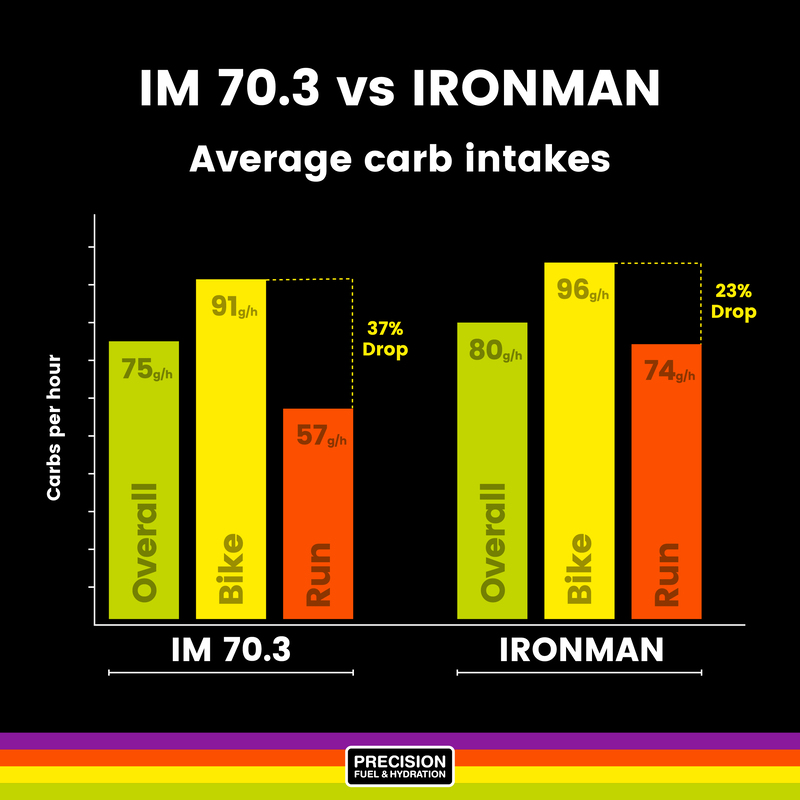
- During the two years that we've been collecting athlete's race nutrition data, IM 70.3 triathletes consumed an average of ~75g of carb per hour - which aligns very nicely with the Fuel & Hydration Planner's recommendation for these middle-distance events ✅
- Of course, your intake will be impacted by race intensity and conditions on the day, so it's no surprise that we saw a wide range of carb numbers, from as little as ~28g/h to a massive ~126g/h
- 70.3ers 'front-loaded' their fueling as they hit ~91g/h on the bike before dropping down to ~57g/h on the run
This 37% drop-off makes sense for two reasons:
- You're able to absorb more earlier in a race, before a combination of gut damage and dehydration occurs
- Front-loading puts you in a position where you don't need to be as aggressive on the run (many athletes find it more difficult to get carbs on board during the run compared to on the bike)
Let's see how our full IRONMAN case studies compare...
- Full-distance triathletes averaged a slightly higher ~80g/h across the whole race - with a range of ~37g/h to ~130g/h
- They also front-loaded by averaging ~96g/h on the bike, before a smaller drop-off to ~74g/h on the run
There are two potential explanations as to why the drop-off from bike-to-run was only 23% for full IRONMAN races:
- IM athletes in our dataset ran an average marathon time of 3:20:01 (vs 70.3ers' time of 1:22:05 for the half marathon). Those racing 140.3 have to run twice the distance and are on their feet for more than double the time, so have to put greater emphasis on keeping their carb intake up to prevent fading in the later stages
- Furthermore, they’re working at a lower intensity on the run, making carb intake easier compared to 70.3
💧 Fluid
- Our cohort also front-loaded their fluid intake, although the drop-off is less pronounced than with fueling...
- 70.3 athletes drank ~706ml/h on the bike leg and ~502ml/h on the run - a 29% difference
- Full IM athletes drank ~865ml/h and ~771ml/h respectively ( -11% )
- This averaged out at ~ 563ml per hour overall for the middle-distance and ~735ml/h for full-distance. It seems likely that IM athletes are drinking more per hour because they need to stay on top of mounting sweat losses over a longer duration
🧂Sodium
- The 70.3 athletes' drinks contained ~1,000mg of sodium per litre on average, compared with IM athletes' ~972mg/L
- We'd expect these numbers to be similar because the relative sodium concentration of your drinks should be geared towards replacing an adequate proportion off your sweat sodium losses
- We know from our Sweat Tests that the average athlete's sweat sodium concentration is ~949mg/L. So, both groups appear to be doing a solid job of replacing their losses
☕ Caffeine
In addition to the 3 levers, caffeine is one of very few supplements that's scientifically proven to provide most athletes with performance benefits...
- So, it's no surprise to see that 96% of IM and 77% of 70.3 athletes utilised caffeine during their races
- We'd expect full distance triathletes to use more caffeine because they're in greater need of a 'boost' to ward off fatigue during this longer format of racing (the average finishing time of our cohort was 9:27:40)
- In fact, their caffeine intake increased from ~ 167mg on the bike to ~ 177mg during the marathon
- In contrast, 70.3 athletes' use of caffeine mirrored carb and fluid intakes as they dropped from ~ 108mg on the bike to ~ 58mg during the half-marathon
- Given the average finish time for the 70.3 distance was 4:15:06, it makes intuitive sense to use the caffeine earlier in the race because it takes ~45 minutes to peak in your bloodstream and has a half-life of 4-5 hours
How they prepared
As well as how you fuel and hydrate during a race, what you eat and drink in the build-up can have an impact on your performance...
⌚ Pre-fuel
- A whopping 82% of the triathletes in our dataset consumed a gel or a chew in the final 30 minutes before their race
- Taking in a final dose of carb before the start will deliver additional fuel to be used in the early stages and increase your energy levels
⌚ Preload
- 83% drank a strong electrolyte drink like PH 1500 before their race
- Preloading will boost your blood volume , a proven way to enhance performance during exercise, especially in the heat
Further reading

Precision Fuel & Hydration and its employees and representatives are not medical professionals, do not hold any type of medical licenses or certifications and do not practice medicine. The information and advice which Precision Fuel & Hydration provides is not medical advice. If customers have any medical questions regarding any advice or information provided by Precision Fuel & Hydration, they should consult their physician, or another healthcare professional.