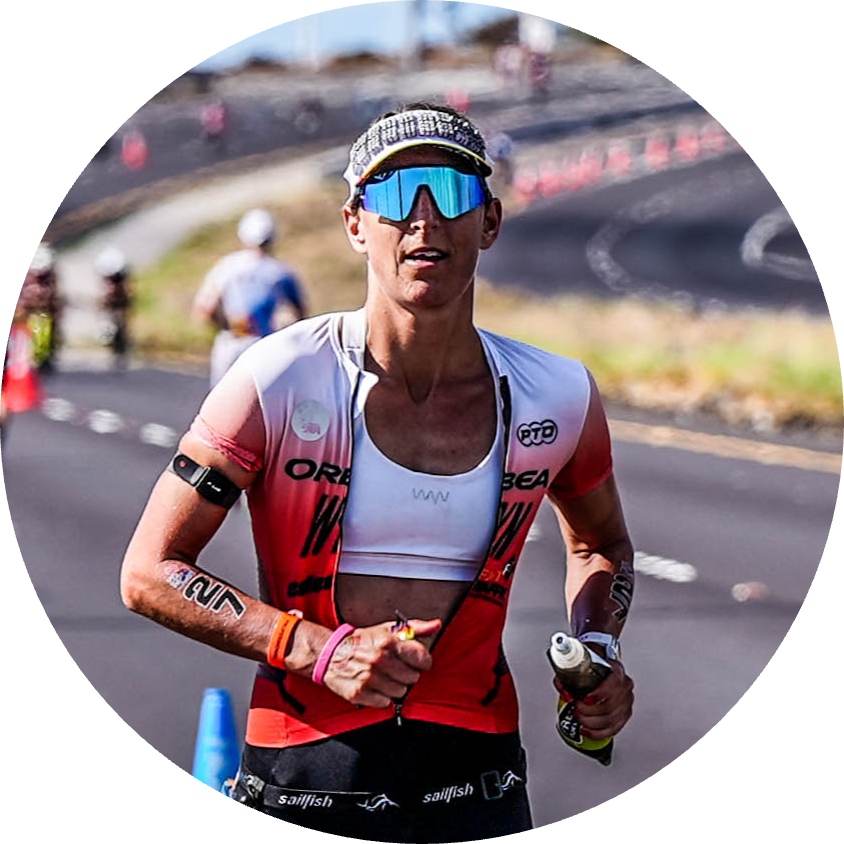
Rebecca Clarke

IRONMAN® World Championships
 Kailua-KonaTop 20, FPRO
Rebecca's headline numbers
Rebecca's strategy
Fueling
T - 1-4hrs: Ate a carb rich meal (Low in fat & fibre)
T - 15mins: Took in a final dose of carb
"The majority of the swim and bike was good, until the last 30km (19 miles) where I felt low, although happily I didn’t lose much power output. During the run, I had waves of high and low energy, with a small amount of stomach pain in the last 7km (4 miles)."
Having worked closely with Rebecca in the lead up to Kona 2023, it was great to see her improve upon the carb intake she achieved at both the IRONMAN European Championships (~69g/h) and IRONMAN New Zealand (~81g/h), which helped her improve on her 2022 Kona time by 20 minutes. Despite a consistent fueling strategy to achieve these numbers, Rebecca felt ‘waves’ of energy while out on the run course. This could be attributed to a combination of accumulated muscular fatigue, the topography of the course and the fluctuations in supportive crowd density that Rebecca experienced during the run.
Hydration
Taking on board an appropriate amount of fluid and sodium is essential to maintaining blood volume and supporting the cardiovascular effort needed to perform on race day.
Whilst the absolute amount of sodium and fluid consumed per hour is important, it’s critical to consider these in relation to each other. This is known as 'relative sodium concentration' and it’s expressed in milligrams per litre (mg/L). How much sodium you’re taking in per litre of fluid is more important than the absolute amount taken in per hour.
Rebecca553mg/L
Rebecca has been Sweat Tested to dial in her hydration plan
Sweat sodium concentration (mg/L) is largely genetically determined and remains relatively stable. Knowing how salty your sweat is enables you to replace a good proportion of your sweat losses, which can range from 200-2,000mg/L.
Whilst Rebecca's losses are on the low side, getting her hydration strategy right is still crucial when it's hot and/or humid as her higher sweat rate in these conditions can result in significant net losses over the duration of a race.
Learn moreT - 60mins: Drank ~500ml of strong electrolyte drink
"It was mentally pretty hard to take when my 950ml (31oz) bottle full of PH 1500 bounced out of my cage less than five minutes into the bike. After this, I made sure that I was really sensible, never missing an aid station and slowing down enough to make sure I definitely got a bottle (especially because it was on the other side of the road to what I’m used to!). I was also hydrated enough to need a pee on the run which was a good sign."
Losing a significant part of your hydration strategy within the first five minutes is not the ideal start to anyone's IM World Championships bike leg. Fortunately, Rebecca had enough information about her personal sweat losses, having undergone a Sweat Test and conducted sweat rate testing. This allowed her to adapt her strategy on the fly during the race, ensuring she consumed an appropriate volume of fluids from aid station pickups while maintaining a proper sodium balance. Despite the heat and humidity making Rebecca's sweat rate higher than when training back home in New Zealand, she was still able to drink enough to match her losses when looking at the high level numbers.
Caffeine
Beyond the Three Levers of Performance (carb, sodium and fluid), caffeine is one of only a few substances that is proven to improve performance for most endurance athletes as it can help stave off mental and physical fatigue.
T - 0-4hrs: Had a final hit of caffeine
Rebecca managed her caffeine intake effectively for this race, surpassing the recommended guidelines slightly to optimise the potential for ergogenic benefits. Notably, Rebecca has previously consumed significantly higher caffeine doses at her past races without experiencing any adverse effects, suggesting that slightly exceeding typical limits doesn't affect her specifically in the detrimental way that it might for others.
How Rebecca hit her numbers
Here's everything that Rebecca ate and drank on the day...
Final thoughts
“Although I finished in a higher position here last year, I’m still 20th in the world and actually finished 20 minutes quicker than when I raced the same course before. There’s always a few little things which I think could’ve gotten me a better result, but overall I’m pretty satisfied with my performance here. It was incredible as a female athlete to have our own standalone day, and I really appreciated all the support from other women on course.”
Rebecca“It was great to see Rebecca optimise her caffeine intake and use her ten years of race experience to adapt her hydration strategy on the fly after losing a bottle early in the race. Rebecca really had to dig deep given the high intensity of the race and the arduous conditions, especially during the run.”
 PF&H
PF&HRebecca's full stats
Data Confidence
We rate each of our case studies from 1-5 based on the level of accuracy, and our confidence in the data.
There is some confidence in the quantities and brands of products consumed but the data may lack specifics (e.g. volumes specific flavours). A high number of estimations have been made and the room for error is moderate-high. There may also be the possibility that some intake has been grossly over- or under-estimated.