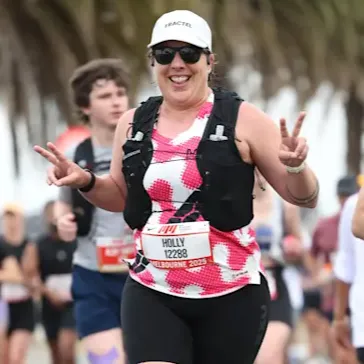
Holly Butler
Melbourne Marathon
 MelbourneCompleted
Holly's headline numbers
Holly's strategy
Fueling
T - 1-4hrs: Ate a carb rich meal (Low in fat & fibre)
T - 15mins: Took in a final dose of carb
"My energy levels were good for the majority of the race and I held my pace well. It was only in the last little bit that it came undone when I started to feel sick."
Holly prepared for the Melbourne Marathon with a 48-hour carb load to maximise her glycogen stores. She further optimised her pre-race fueling with a carb-rich breakfast followed by a PF 30 Gel as she walked to the start line. During her PB pursuit, Holly had a clear fueling plan, which she stuck to brilliantly. Taking one PF 30 Gel every 30 minutes gave her a consistent supply of ~60g of carbohydrate per hour, in line with the recommendations for an event of this duration and intensity.
Hydration
Taking on board an appropriate amount of fluid and sodium is essential to maintaining blood volume and supporting the cardiovascular effort needed to perform on race day.
Whilst the absolute amount of sodium and fluid consumed per hour is important, it’s critical to consider these in relation to each other. This is known as 'relative sodium concentration' and it’s expressed in milligrams per litre (mg/L). How much sodium you’re taking in per litre of fluid is more important than the absolute amount taken in per hour.
Drinking a strong electrolyte drink before the race could have helped Holly start optimally hydrated
"I had some twinges of cramps which I think might’ve been hydration related because I didn’t finish the electrolytes I was carrying. "
Holly carried two 500ml soft flasks of an electrolyte drink mix in her race vest. Unfortunately, flavour fatigue set in and she only managed to consume half of her second berry flavoured drink. This reduced her sodium intake below what she had planned and likely below what she was losing in her sweat. For the rest of the marathon, Holly picked up plain water along the course, making sure to slow down through the aid stations to maximise the fluid she was able to get onboard. Overall, she drank an average of ~622ml/h which would have replaced a good proportion of her sweat losses in the mild conditions. Despite this, she experienced some cramping from 35km onwards alongside some GI discomfort. Although this was an improvement from the extreme cramping she experienced from 15km onwards during her last marathon, Holly may benefit from further increasing the relative sodium concentration of her intake to better manage fluid balance within the body to reduce her risk of cramp. For example, she could carry Electrolyte Capsules to pair with plain water picked up on course.
Caffeine
Beyond the Three Levers of Performance (carb, sodium and fluid), caffeine is one of only a few substances that is proven to improve performance for most endurance athletes as it can help stave off mental and physical fatigue.
Consuming caffeine in the hours before the start may have increased perceived energy levels
Other than a coffee to start the day, Holly didn’t include caffeine in her race day nutrition plan as it doesn’t sit well in her stomach. While caffeine can provide ergogenic effects, it’s only beneficial to performance if it’s well tolerated. In this case, the ‘optimal’ approach for Holly specifically, is to *not* use caffeine.
How Holly hit her numbers
Here's everything that Holly ate and drank on the day...
Final thoughts
“I’m really proud of my preparation and execution of this race. I can’t wait to go for it again next year!”
Holly“Taking an hour and a half off her marathon time in 12 months is a testament to Holly’s hard work in training, dedication to the race and consistency in working to improve her fuel and hydration strategy. Ahead of the same race next year, Holly could work to increase her relative sodium concentration to hopefully prevent any cramping and support her to another personal best.”
 PF&H
PF&HHolly's full stats
Data Confidence
We rate each of our case studies from 1-5 based on the level of accuracy, and our confidence in the data.
There is an adequate level of accuracy in the data collected and the numbers reported. The athlete manages to recall what they ate and drank including most specifics (brands flavours quantities plausible estimations of volumes). However there are estimations made within the data which affect the overall confidence level in the data reported.