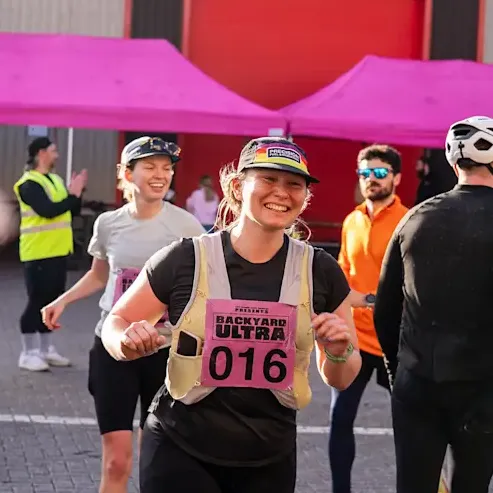
Lucy White
Left Handed Giant Backyard Ultra

Lucy's headline numbers
Lucy's strategy
Fueling
Carbohydrate is the main fuel you burn when racing. Failing to fuel properly is a leading cause of underperformance in longer races.
A Backyard Ultra follows a unique structure with athletes running 6.7km on the hour every hour, in this case for 12 hours! While this structure comes with fueling quantity and timing considerations, the relatively steady intensity and duration of the event meant a carbohydrate intake of ~60g/h was recommended, a target Lucy came very close to. The key to Lucy’s fueling success, which left her feeling like a “different person” compared to past races, was her consistency. To hit 53g/h while maintaining a gut comfort rating of 9/10, Lucy used PF 300 Flow Gel or a PF 90 Gel every lap to ensure that she consumed carbohydrates while on the move, reducing the pressure to eat during the short breaks. Then in the 10-20 minutes between laps, Lucy relied more on real food to help prevent flavour fatigue and to have something to look forward to. These foods were all high in carbohydrates and low in fat and fibre, which helped them to be absorbed and utilised without any gut issues.
Hydration
Taking on board an appropriate amount of fluid and sodium is essential to maintaining blood volume and supporting the cardiovascular effort needed to perform on race day.
Whilst the absolute amount of sodium and fluid consumed per hour is important, it’s critical to consider these in relation to each other. This is known as 'relative sodium concentration' and it’s expressed in milligrams per litre (mg/L). How much sodium you’re taking in per litre of fluid is more important than the absolute amount taken in per hour.
Lucy went into the event well hydrated following her preload of PH 1500 (Tablets) in 500ml the night before and during the morning of the event. During the event, Lucy then primarily consumed PH 1000 (Tablets) to replace an appropriate proportion of her sweat sodium losses. Given the cold conditions of Bristol in January (~6℃ / 43°F) and the low relative intensity that this type of race involves, Lucy’s sweat rate would’ve been relatively low. She replaced these losses consistently, by taking a big sip of PH 1000 at the same points on each lap to be proactive with her hydration. Body weight measurements before and after the race proved that Lucy maintained a well hydrated state as she didn’t experience a reduction in body weight greater than the scientifically established tolerable threshold of 2%.
Caffeine
Beyond the Three Levers of Performance (carb, sodium and fluid), caffeine is one of only a few substances that is proven to improve performance for most endurance athletes as it can help stave off mental and physical fatigue.
Lucy’s caffeine intake of two coffees, one after lap 4 and one after lap 8, got her within the recommended dose of 3-6mg/kg for an endurance event. She found that the timings of her doses helped to mentally pick her up and helped her through the middle portion of the 12-hour race.
How Lucy hit her numbers
Here's everything that Lucy ate and drank on the day...
Lucy's weapons of choice
Final thoughts
Lucy PF&H
PF&HLucy's full stats
Data Confidence?
There is a high level of confidence in the accuracy in the data. The numbers presented are believed to be a very close reflection of reality. There may still be one or two estimations made in the data (an inescapable part of field data) but there is reason to believe that these are accurate and that possible error has been kept to a minimum. It is data that has been collected and recalled as accurately as is possible given the uncontrolled settings/circumstances.