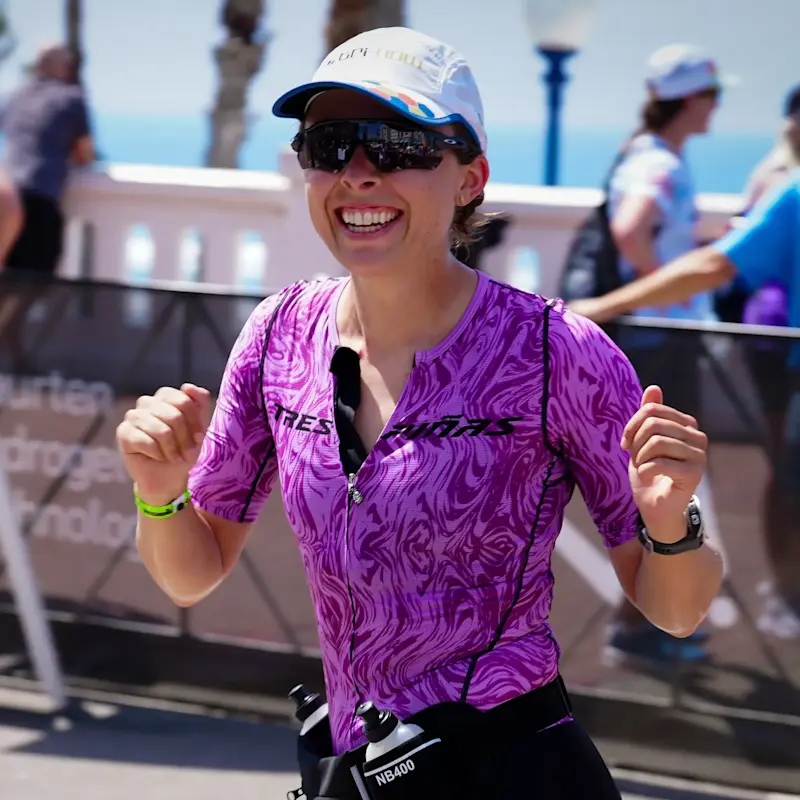
Erin Hervey
IRONMAN 70.3® Oceanside

Erin's headline numbers
Erin's strategy
Fueling
Carbohydrate is the main fuel you burn when racing. Failing to fuel properly is a leading cause of underperformance in longer races.
Erin went into IRONMAN® 70.3 Oceanside with a clear fueling plan. A carb-rich breakfast and final ~16g dose of carb before the start helped her to enter the swim well fueled. On the bike, Erin primarily used Carb & Electrolyte Drink Mix and PF 30 Chews to deliver ~63g of carb per hour, hitting the recommended intake for a race of this intensity over a 6 hour 49 minute duration. On the run, Erin mixed three scoops of Carb & Electrolyte Drink Mix in each of two 200ml flasks providing her with ~41g/h. To better support her energy levels towards the end of the race, Erin should work to increase her overall intake to reach the recommended range. She’ll benefit from continuing to train her gut so she can accomplish this, and eventually be able to take on an additional PF 30 Gel each hour of the run.
Hydration
Taking on board an appropriate amount of fluid and sodium is essential to maintaining blood volume and supporting the cardiovascular effort needed to perform on race day.
Whilst the absolute amount of sodium and fluid consumed per hour is important, it’s critical to consider these in relation to each other. This is known as 'relative sodium concentration' and it’s expressed in milligrams per litre (mg/L). How much sodium you’re taking in per litre of fluid is more important than the absolute amount taken in per hour.
In the hours before the race start, Erin drank a carb and electrolyte drink mix in an attempt to start well hydrated, but this only had a relative sodium concentration of 800mg/L, meaning it would not have provided the water retention effects of a preload. Going forwards, she should consider substituting this drink mix for PH 1500 - a drink with a higher relative sodium concentration - to ensure she starts optimally hydrated, especially ahead of a warm race. Erin began the bike with three 700ml bottles on her bike, two containing Carb & Electrolyte Drink Mix and one with PH 1500 to appropriately replace both her fluid and sodium losses. When she realised the bike leg was going to take longer than she had expected due to the heat, Erin adapted well by picking up PH 1000 from the final aid station to ensure she didn’t accumulate too much of a hydration deficit ahead of the run.
During the half marathon, the California sun started to get to Erin, as she is used to the mountain chill of Utah. She carried two flasks of over-concentrated Carb & Electrolyte Drink Mix then picked up PH 1000 from aid stations. This meant the relative sodium concentration of her intake on the run was a whopping 2507mg/L; next time, we would suggest she either mixes the drink mix as suggested or picks up plain water from the aid stations to dilute the concentration closer to that of her losses. As Erin alluded to post-race, ahead of future hot races she would benefit from undergoing a block of heat training so she is able to better maintain her pace when her core body temperature rises.
Caffeine
Beyond the Three Levers of Performance (carb, sodium and fluid), caffeine is one of only a few substances that is proven to improve performance for most endurance athletes as it can help stave off mental and physical fatigue.
Caffeine can provide performance benefits such as reduced perception of fatigue and increased concentration, but it is not - and should not be - used by everyone. Since Erin doesn’t consume caffeine in her daily life or training, she keeps it out of her race strategy, highlighting how whilst something can be beneficial on paper that doesn’t mean it is right for all athletes.
How Erin hit her numbers
Here's everything that Erin ate and drank on the day...
Erin's weapons of choice
Final thoughts
Erin PF&H
PF&HErin's full stats
Data Confidence?
There is good confidence in the accuracy of the data reported. An athlete feels that the numbers closely reflect what they consumed despite a couple of estimations which may carry some degree of error. The majority of what was consumed is recorded to a high level of specificity (most volumes are known through the use of bottles brands quantities flavours). The numbers are very plausible and align with previous data recordings (if an athlete has collected data previously).