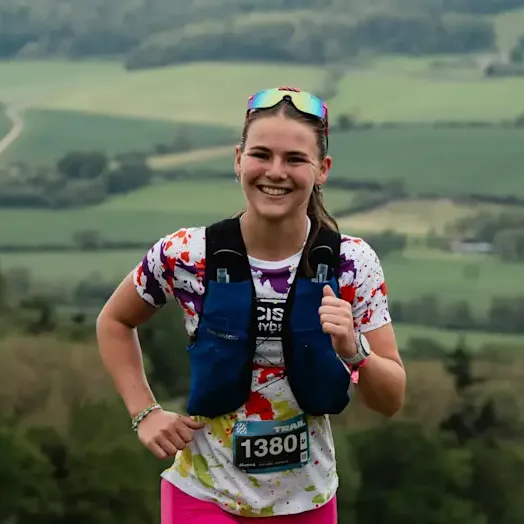
Emily Sutton
Maverick Cotswolds Ultra

Emily's headline numbers
Emily's strategy
Fueling
Carbohydrate is the main fuel you burn when racing. Failing to fuel properly is a leading cause of underperformance in longer races.
As a hockey player stepping into the endurance world, Emily from the PF&H Sports Science team was met with the new challenge of carb loading and fueling with more than just a couple of sweets at halftime! However, she practised what she preaches, and hit the pre-race fueling recommendations with ~9.5g carb per kg bodyweight in the 48 hours before and topped that up with 2.8g/kg on race morning. When she signed up for this race in February, like many new endurance athletes, Emily struggled to take even one gel without GI issues. But through consistent gut training, she increased her tolerance and was able to take on ~58g carb per hour with no problems on race day.
Hydration
Taking on board an appropriate amount of fluid and sodium is essential to maintaining blood volume and supporting the cardiovascular effort needed to perform on race day.
Whilst the absolute amount of sodium and fluid consumed per hour is important, it’s critical to consider these in relation to each other. This is known as 'relative sodium concentration' and it’s expressed in milligrams per litre (mg/L). How much sodium you’re taking in per litre of fluid is more important than the absolute amount taken in per hour.
Sweat sodium concentration (mg/L) is largely genetically determined and remains relatively stable. Knowing how salty your sweat is enables you to replace a good proportion of your sweat losses, which can range from 200-2,000mg/L.
Whilst Emily’s losses are on the moderate side, getting her hydration strategy right is still important if she wants to perform at her best.
Learn moreAlthough Emily preloaded with 500ml of PH 1500 (Tablets) the evening before and morning of the race, the smoothie and glass of water she had with breakfast would have diluted the effects of her morning electrolyte drink. Going forward, she should have additional sodium, potentially through Electrolyte Caspules, alongside this fluid or remove it entirely to optimise the water retention benefits of the preload protocol. During the race, the “very English” conditions of 12℃ and raining in mid-May meant Emily’s hydration strategy of one flask of plain water per hour paired with two Electrolyte Capsules would have likely been appropriate to keep her well hydrated across the race.
Caffeine
Beyond the Three Levers of Performance (carb, sodium and fluid), caffeine is one of only a few substances that is proven to improve performance for most endurance athletes as it can help stave off mental and physical fatigue.
Emily doesn’t regularly drink coffee and didn’t train with caffeine gels, so she opted to keep them out of her race day strategy. Whilst caffeine can provide performance enhancing effects for athletes, it is not well tolerated by all athletes. Going forward, if she wanted to trial using PF 30 Caffeine Gels, Emily should aim for 3-6mg/kg to provide the best chance for her to feel the stimulant’s performance benefits.
How Emily hit her numbers
Here's everything that Emily ate and drank on the day...
Emily's weapons of choice
Final thoughts
Emily PF&H
PF&HEmily's full stats
Data Confidence?
There is an adequate level of accuracy in the data collected and the numbers reported. The athlete manages to recall what they ate and drank including most specifics (brands flavours quantities plausible estimations of volumes). However there are estimations made within the data which affect the overall confidence level in the data reported.