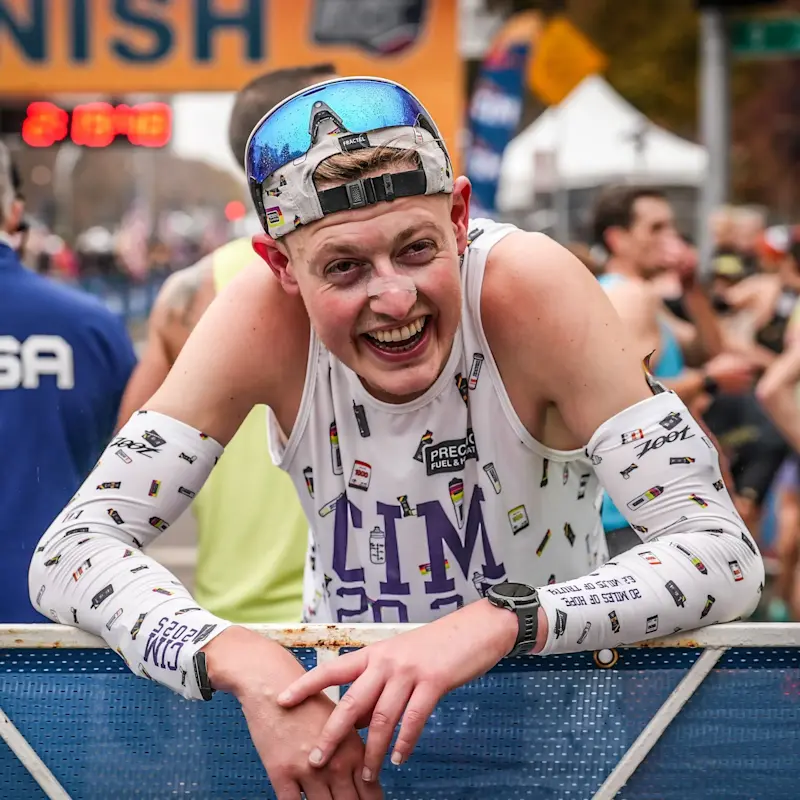
Hugo Fry

California International Marathon

Hugo's headline numbers
Hugo's strategy
Fueling
Carbohydrate is the main fuel you burn when racing. Failing to fuel properly is a leading cause of underperformance in longer races.
Hugo worked with Senior Sport Scientist, Lindsey, to dial in his pre-race fueling routine ahead of the California International Marathon (CIM). A bowl of rice with maple syrup, followed by a PF 60 Chew Bar in the hours before the start then topped up his liver glycogen stores after a night’s sleep and a successful 12g/kg carb-load the day before. Hugo completed his pre-race nutrition strategy with a PF 30 Caffeine Gel within 10 minutes of the race, ensuring he raised his blood glucose levels. Once on the move, Hugo consumed an impressive ~98g of carbohydrate per hour through one PF 90 Gel, three PF 30 Gels and some on-course Carb & Electrolyte Drink Mix which he picked up in cups at the aid stations. He slightly changed his fuel consumption tactic by sipping his gels instead of taking them all at once and felt this helped the high carb intake sit better in his stomach.
Hydration
Taking on board an appropriate amount of fluid and sodium is essential to maintaining blood volume and supporting the cardiovascular effort needed to perform on race day.
Whilst the absolute amount of sodium and fluid consumed per hour is important, it’s critical to consider these in relation to each other. This is known as 'relative sodium concentration' and it’s expressed in milligrams per litre (mg/L). How much sodium you’re taking in per litre of fluid is more important than the absolute amount taken in per hour.
Sweat sodium concentration (mg/L) is largely genetically determined and remains relatively stable. Knowing how salty your sweat is enables you to replace a good proportion of your sweat losses, which can range from 200-2,000mg/L.
Given Hugo’s losses are High (1,344mg/L), nailing his hydration strategy remains important, even when it’s Cold.
Learn moreSince discovering that he is a very salty sweater from his Sweat Test at PF&H HQ in October, Hugo has incorporated more sodium into both his training sessions and his race-day plan. At CIM, he nailed his sodium strategy by preloading both the night before and morning of the race with PH 1500 and then using Electrolyte Capsules and cups of Carb & Electrolyte Drink Mix during the event to maintain a relative sodium concentration of 1500mg/L to closely matched his sweat sodium losses. This is a massive improvement on the ~215mg/L that he consumed at the Berlin Marathon earlier this year and helped him to avoid the severe muscle cramping he has experienced in the past. While the cold weather (~5℃) would’ve kept Hugo’s sweat losses relatively low, he still experienced a -2.65% body mass change, which is considered to be a fairly moderate level of dehydration. Going forwards, he would likely benefit from slightly increasing his fluid intake to better match his sweat losses and ensure he loses no more than a 2% drop.
Caffeine
Beyond the Three Levers of Performance (carb, sodium and fluid), caffeine is one of only a few substances that is proven to improve performance for most endurance athletes as it can help stave off mental and physical fatigue.
Other than his pre-race PF 30 Caffeine Gel, Hugo doesn’t utilise caffeine in his race day plan. While caffeine can provide significant ergogenic effects, it is not used by (or appropriate for) every athlete, and since he doesn’t notice a benefit from it, Hugo was right to not include it in his race strategy.
How Hugo hit his numbers
Here's everything that Hugo ate and drank on the day...
Hugo's weapons of choice
Final thoughts
Hugo PF&H
PF&HHugo's full stats
Data Confidence?
There is good confidence in the accuracy of the data reported. An athlete feels that the numbers closely reflect what they consumed despite a couple of estimations which may carry some degree of error. The majority of what was consumed is recorded to a high level of specificity (most volumes are known through the use of bottles brands quantities flavours). The numbers are very plausible and align with previous data recordings (if an athlete has collected data previously).