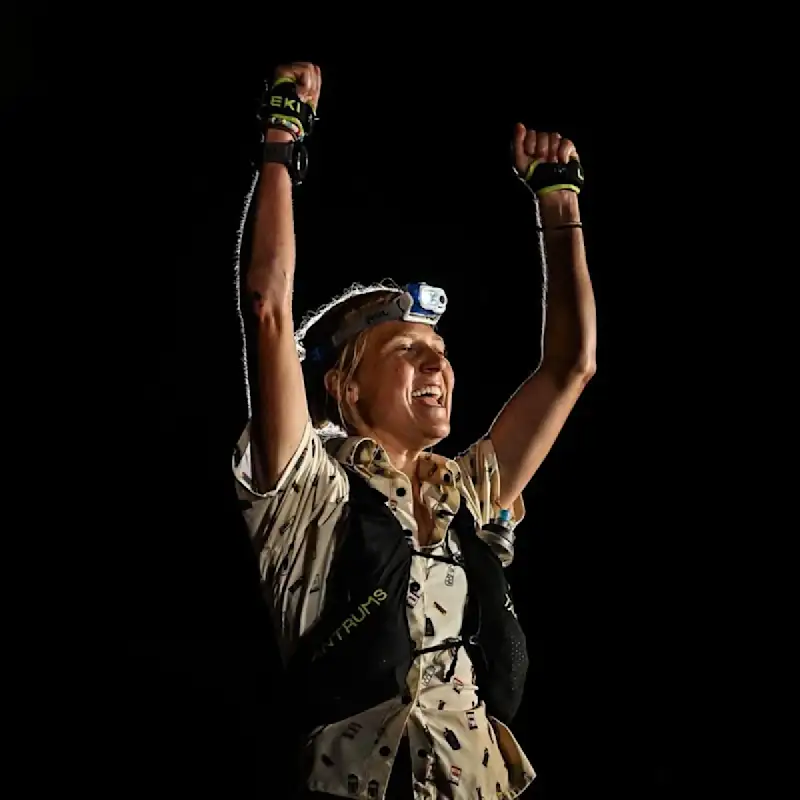
Rachel Entrekin


Pass Mountain 50 mile

Rachel's headline numbers
Rachel's strategy
Fueling
Carbohydrate is the main fuel you burn when racing. Failing to fuel properly is a leading cause of underperformance in longer races.
Although Rachel averaged ~70g of carbohydrate per hour, this was not consistent across the ~8.5 hour effort. Her intake dipped significantly during the hot, exposed stretch from mile 27, where she also ran low on fluids. This combination of dehydration and underfueling for the intensity likely contributed to the dip in energy she reported after this section. She sensibly got right back on track with some easily digested carbs in the form of coca cola along with Carb & Electrolyte Drink Mix and half a PF 60 Chew Bar to bring her energy levels back up for the final push.
To better support her performance over races of this intensity and duration, she should aim for a more consistent fueling approach and work to bring her carb intake up towards 90g/h. A race like this is unlike her much longer efforts at a lower relative intensity, where fat makes up a greater proportion of her substrate metabolism, so we’d recommend shifting accordingly to match the energy demands of each race.
Hydration
Taking on board an appropriate amount of fluid and sodium is essential to maintaining blood volume and supporting the cardiovascular effort needed to perform on race day.
Whilst the absolute amount of sodium and fluid consumed per hour is important, it’s critical to consider these in relation to each other. This is known as 'relative sodium concentration' and it’s expressed in milligrams per litre (mg/L). How much sodium you’re taking in per litre of fluid is more important than the absolute amount taken in per hour.
Sweat sodium concentration (mg/L) is largely genetically determined and remains relatively stable. Knowing how salty your sweat is enables you to replace a good proportion of your sweat losses, which can range from 200-2,000mg/L.
Given Rachel’s losses are Very High (1,515mg/L), nailing her hydration strategy remains important, even when it’s Mild.
Learn moreGiven the 6am race start, Rachel chose to have her caffeinated energy drink along with some water pre-race. Ahead of future long and especially hot races, she should preload with 1 x PH 1500 Tablet in 500ml to make sure she is starting on the front foot with elevated blood plasma volume and a stronger hydration status.
During the race, her intake kept up with her losses overall, avoiding any noticeable decline in performance. Similarly to her fueling, the ~8.7L she drank over the race wasn’t distributed evenly, particularly in the second half of the race when she ran out of fluid before the aid stations at miles 34 and 43. She used two 500ml soft flasks, alternating between PF Carb & Electrolyte Drink Mix and water, but may have benefited from carrying an extra handheld to enable drinking more as temperatures rose. Given the volume of plain water she drank compared to her Carb & Electrolyte Drink Mix, her relative sodium concentration was also below her sweat sodium losses (Rachel is a very salty sweater losing over 1500mgL). In future, she would likely benefit from replacing her sodium losses at a rate more similar to her sweat by consuming Electrolyte Capsules alongside her flasks of plain water.
Caffeine
Beyond the Three Levers of Performance (carb, sodium and fluid), caffeine is one of only a few substances that is proven to improve performance for most endurance athletes as it can help stave off mental and physical fatigue.
As an experienced ultra-endurance athlete, Rachel is used to racing on very little sleep and tactically using caffeine to her advantage (for example, she won Mammoth 200 earlier in 2025 with 0 hours of sleep!). In this daytime 50 miler, she had a caffeinated energy drink pre-race and topped up with some coca cola towards the back end of the run. Given she has a high tolerance for the stimulant, she may benefit from taking more frequent doses across races, such as one or two PF 30 Caffeine Gels or additional cola to reach the 3-6mg/kg guidelines and maximise the ergogenic effects.
How Rachel hit her numbers
Here's everything that Rachel ate and drank on the day...
Rachel's weapons of choice
Final thoughts
Rachel PF&H
PF&HRachel's full stats
Data Confidence?
There is an adequate level of accuracy in the data collected and the numbers reported. The athlete manages to recall what they ate and drank including most specifics (brands flavours quantities plausible estimations of volumes). However there are estimations made within the data which affect the overall confidence level in the data reported.