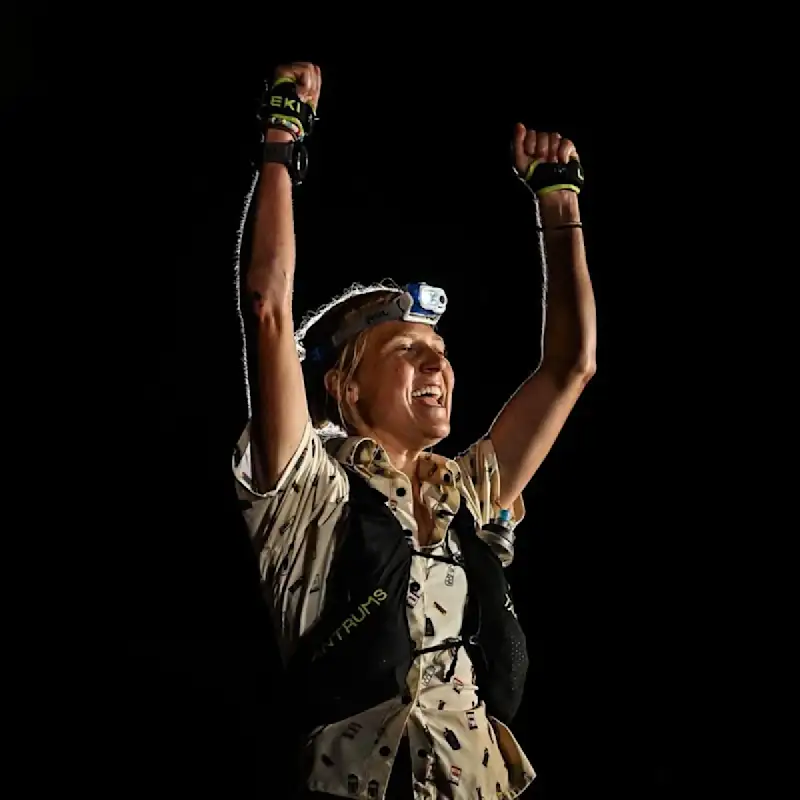
Rachel Entrekin


Ultra Trail Chianti Castles

Rachel's headline numbers
Rachel's strategy
Fueling
Carbohydrate is the main fuel you burn when racing. Failing to fuel properly is a leading cause of underperformance in longer races.
Rachel headed out to Italy with the PF&H Sports Science team to sample some very authentic pasta and pizza, as well as many a PF 30 Chew in the few days before the race. This would’ve helped top up her glycogen stores to some extent, but in the future she’s going to work on implementing a structured carb load in the 24-48 hours pre-race, aiming to consume ~8-12g/kg of carbohydrate.
During the race, Rachel was remarkably consistent with her carb intake as she hit ~66g/h by consuming a combination of PF Carb & Electrolyte Drink Mix, PF 30 Chews, PF 60 Chew Bars, PF 30 Gels and Cola or Fanta. For the first 37.5km, she averaged ~67g/h, and Rachel found the gels were going down well, so after feeding this back to her crew chief, Emily, the plan was adjusted on the fly to incorporate a greater proportion of PF 30 Gels to hit her target of 60g/h. Although below the top end of the recommended 90g/h when racing at this intensity and duration, this goal was based on what her gut can tolerate and her last race, Coldwater Rumble 100 miler where her intake slowly declined across the course, dropping below 60g/h and impacting her energy levels. She never dropped below ~57g/h in Chianti and at times reached ~75g/h, which allowed Rachel to sustain her high race intensity and battle it out with Courtney Dauwalter and Yngvild Kaspersen for podium positions.
Hydration
Taking on board an appropriate amount of fluid and sodium is essential to maintaining blood volume and supporting the cardiovascular effort needed to perform on race day.
Whilst the absolute amount of sodium and fluid consumed per hour is important, it’s critical to consider these in relation to each other. This is known as 'relative sodium concentration' and it’s expressed in milligrams per litre (mg/L). How much sodium you’re taking in per litre of fluid is more important than the absolute amount taken in per hour.
Sweat sodium concentration (mg/L) is largely genetically determined and remains relatively stable. Knowing how salty your sweat is enables you to replace a good proportion of your sweat losses, which can range from 200-2,000mg/L.
Given Rachel’s losses are Very High (1,515mg/L), nailing her hydration strategy remains important, even when it’s Cold.
Learn moreAs a salty sweater, Rachel has struggled in previous races and training to keep up with her sweat sodium losses. To start hydrated, she preloaded the day before and on race morning to make sure she started hydrated before being more proactive with her sodium replacement from the gun. During the race, her hydration strategy involved carrying two 600ml soft flasks, one containing PF Carb & Electrolyte Drink Mix and the other plain water. This time out, Rachel took a strip of three Electrolyte Capsules from her crew with every flask of plain water, averaging a higher relative sodium concentration across the first half of the race. Her relative sodium intake decreased later in the race as she prioritised increasing her fluid intake as the temperatures rose by drinking additional Cola and Fanta at crewed aid stations. As a result, her fluid intake across the race was well judged for the mild conditions, and her sodium replacement was enough to avoid any performance decline. It’s worth making sure the relative sodium concentration of her intake is maintained, especially when losses are high in future races, for example, with the help of more Electrolyte Capsules alongside any extra fluid.
Caffeine
Beyond the Three Levers of Performance (carb, sodium and fluid), caffeine is one of only a few substances that is proven to improve performance for most endurance athletes as it can help stave off mental and physical fatigue.
Rachel started the day with a caffeinated energy drink, which would have elevated her circulating caffeine levels for the 4am race start. During the race itself, her caffeine intake came only through Cola and Red Bull at crewed aid stations at the back end of the race. Though the timing of her caffeine doses was well spread, with the relatively low caffeine content of these drinks, her intake didn’t reach the scientifically backed 3-6mg/kg guidelines. In future training and racing, she may want to consider testing out higher doses of caffeine by using PF 30 Caffeine Gels, as the 100mg caffeine dose would pack a larger punch and put her in the range to benefit from the stimulant's ergogenic effects.
How Rachel hit her numbers
Here's everything that Rachel ate and drank on the day...
Rachel's weapons of choice
Final thoughts
Rachel PF&H
PF&HRachel's full stats
Data Confidence?
There is a high level of confidence in the accuracy in the data. The numbers presented are believed to be a very close reflection of reality. There may still be one or two estimations made in the data (an inescapable part of field data) but there is reason to believe that these are accurate and that possible error has been kept to a minimum. It is data that has been collected and recalled as accurately as is possible given the uncontrolled settings/circumstances.