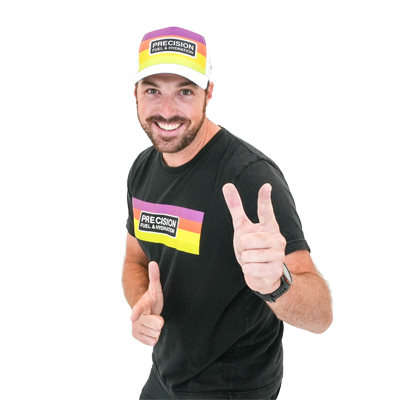
Brad Williams
California International Marathon

Brad's headline numbers
Brad's strategy
Fueling
Carbohydrate is the main fuel you burn when racing. Failing to fuel properly is a leading cause of underperformance in longer races.
After being convinced to take the start line just days before the race, Brad’s build up and training weren’t ideal heading into the highly competitive California International Marathon (CIM). Luckily as a life-long athlete, he knew that his fueling (and hydration) would play a critical role in getting him through the 42.2km (26.2 miles) in one piece. Before the 7am race start he began the day with ~1.2g/kg of carbohydrate to top up his glycogen stores, followed by a PF 30 Caffeine Gel and PF 60 Chew Bar within the last 30 minutes to raise his blood glucose levels and energy availability.
Having averaged over 90g/h in recent ultra races, Brad’s typical high-carb intake and long-term gut training allowed him to tolerate large amounts of fuel mid-race comfortably, averaging ~109g/h. His slight dip in perceived energy came after a misunderstanding with mile markers and aid stations that meant he did not have his planned PF 30 Gel between mile 17 and 21. While he doesn’t believe this was the sole reason for his fade towards the end, prioritising a more self-sufficient approach with fixed fueling intervals in future races may help avoid energy dips and better support his performance all the way to the end.
Hydration
Taking on board an appropriate amount of fluid and sodium is essential to maintaining blood volume and supporting the cardiovascular effort needed to perform on race day.
Whilst the absolute amount of sodium and fluid consumed per hour is important, it’s critical to consider these in relation to each other. This is known as 'relative sodium concentration' and it’s expressed in milligrams per litre (mg/L). How much sodium you’re taking in per litre of fluid is more important than the absolute amount taken in per hour.
Sweat sodium concentration (mg/L) is largely genetically determined and remains relatively stable. Knowing how salty your sweat is enables you to replace a good proportion of your sweat losses, which can range from 200-2,000mg/L.
Whilst Brad’s losses are on the moderate side, getting his hydration strategy right is still important if he wants to perform at his best.
Learn moreBrad drank over 1.5L ahead of the early 7am race start. Although this fluid contained a high sodium concentration, 1,500mg/L, this large volume likely played a part in him needing a portaloo stop after 16km (10 miles). In contrast, 500ml of PH 1500 in the 2 hours before the race would have been more optimal for his race morning preload to make sure he was starting well hydrated without overdoing it. With race temperatures averaging 6℃ / 43°F, Brad relied on thirst to guide his intake from the 17 on-course aid stations. He drank close to ~1.5L across the 3 hours 20 minutes to sufficiently keep up with his low-to-moderate sweat losses. Brad used a decoupled fuel and hydration strategy by relying on PF 30 Gels for carbs, plain water for fluids and Electrolyte Capsules for sodium. This gave him the flexibility to manage his fluid and sodium needs separately and at a concentration aligned with his individual sweat losses without impacting his fueling - a solid and common approach for marathon racing.
Caffeine
Beyond the Three Levers of Performance (carb, sodium and fluid), caffeine is one of only a few substances that is proven to improve performance for most endurance athletes as it can help stave off mental and physical fatigue.
Brad’s caffeine intake was simple and effective, consuming one PF 30 Caffeine Gel pre-race and then spreading three more across the marathon. This put his total intake at ~400mg caffeine (~4.3mg/kg) which is right in the sweet spot of the recommended dose for a race of this duration. This will have provided the ergogenic effects of the stimulant, including increased alertness and reduced perceived effort without getting close to the high doses that can lead to negative side effects.
How Brad hit his numbers
Here's everything that Brad ate and drank on the day...
Brad's weapons of choice
Final thoughts
Brad PF&H
PF&HBrad's full stats
Data Confidence?
There is good confidence in the accuracy of the data reported. An athlete feels that the numbers closely reflect what they consumed despite a couple of estimations which may carry some degree of error. The majority of what was consumed is recorded to a high level of specificity (most volumes are known through the use of bottles brands quantities flavours). The numbers are very plausible and align with previous data recordings (if an athlete has collected data previously).