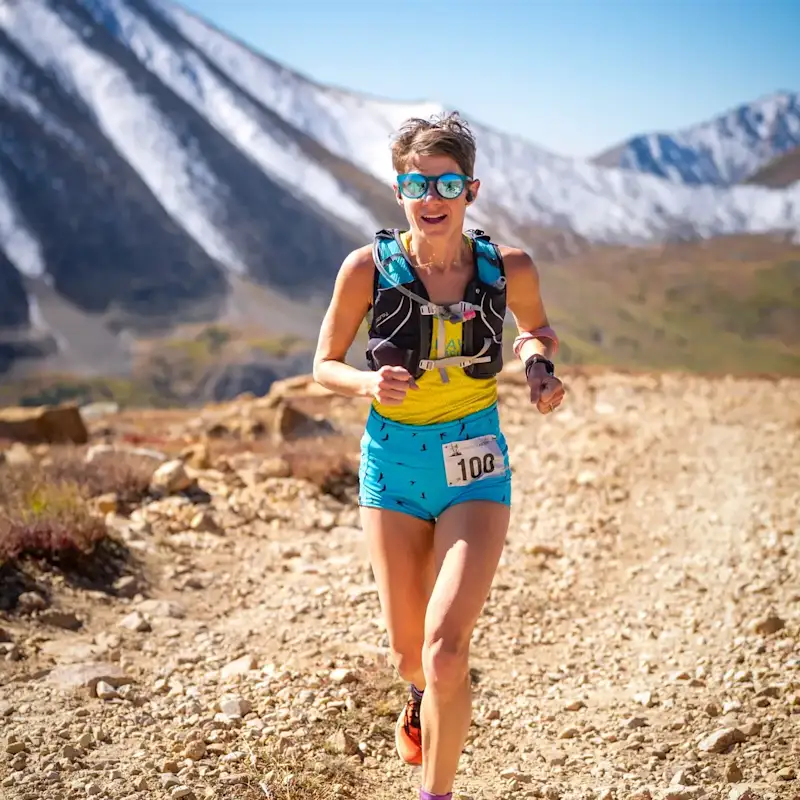
Lauren Puretz


Ultra Trail Chianti Castles

Lauren's headline numbers
Lauren's strategy
Fueling
Carbohydrate is the main fuel you burn when racing. Failing to fuel properly is a leading cause of underperformance in longer races.
Lauren's race day actually started at ~2am - up early for cookies and a half-cup of espresso before heading to the start line in the dark. The Ultra Trail Chianti Castles began at 4:00am, in temperatures of just 2°C (36 F), with strong winds working their way across the Chianti Senese hills.
Historically, Lauren hasn’t operated at her best in cold conditions, which explains why her energy rating started at a 6/10 and her carb intake in the opening Radda to Castello di Brolio section sat at ~77g/h - her lowest of the day. As temperatures lifted and the course began to climb toward Monteluco, her appetite returned and intake followed, rising to ~95g/h and peaking at ~97g/h through Cantalici. That energy rating improved to 8/10 in the second half, which is actually the opposite trajectory to most athletes in an ultra - rather than fading, she felt stronger across ~12.5 hours.
The most notable drop came from the section between checkpoints at Cantalici to Gaiole in Chianti, where her fueling fell to ~69g/h; the descent has a technical, rooty terrain that demands full concentration, and eating in those conditions is difficult. She managed to recover her carb intake through the climbing sections - ~80g/h to Castello di Albola and ~87g/h up to Villa San Michele - before tailing off naturally to ~76g/h in the final push home.
Since Western States in 2024, which is the last race where PF&H Sports Scientist, Tash, crewed Lauren, the most significant improvement was the complete absence of GI issues. At WSER, Lauren's stomach GI rating was 4/10 and cost her close to an hour in walking time due to that discomfort. Going into Chianti, she had focused on gut training in the months beforehand, and there was no discomfort as a result of this effort - she ate and drank throughout without any issues from start to finish. PF Carb & Electrolyte Drink Mix, PF 90 Gels, PF 30 Gels and small amounts of cola at aid stations made up the bulk of her intake, with the cola providing a useful flavour change across a long race. Her intake at ~81g/h - up from ~67g/h at WSER 2024 - was a tangible improvement and a direct reflection of better gut tolerance.
Hydration
Taking on board an appropriate amount of fluid and sodium is essential to maintaining blood volume and supporting the cardiovascular effort needed to perform on race day.
Whilst the absolute amount of sodium and fluid consumed per hour is important, it’s critical to consider these in relation to each other. This is known as 'relative sodium concentration' and it’s expressed in milligrams per litre (mg/L). How much sodium you’re taking in per litre of fluid is more important than the absolute amount taken in per hour.
Sweat sodium concentration (mg/L) is largely genetically determined and remains relatively stable. Knowing how salty your sweat is enables you to replace a good proportion of your sweat losses, which can range from 200-2,000mg/L.
Whilst Lauren’s losses are on the moderate side, getting her hydration strategy right is still important if she wants to perform at her best.
Learn moreChianti poses a very different hydration challenge to WSER. With an early and cold start with strong winds, Lauren's sweat rate in the early hours would have been considerably lower than when racing in the heat of California; this was reflected in her low fluid intake of ~316ml/h from Radda to Castello di Brolio, her lowest of the day. She peed just twice across the entire race, which, in the context of cool conditions and a relatively low sweat rate, is an appropriate response rather than a sign of under-drinking.
Despite the milder temperatures, her approach to moderate her fluid intake across the race, and even further the way she carried it, was deliberate. Lauren chose to run with a fluid reservoir in the back of her pack and supplemented this with soft flasks stored in the front for longer sections - not because she enjoys the setup, but because the presence of fluid on her back is a useful prompt to drink more consistently.
As the morning warmed and the climbing began, fluid intake stepped up considerably, peaking at ~815ml/h through the short Monteluco to Cantalici section. This was a front-loading effort ahead of the Cantalici to Gaiole in Chianti leg, where there was no access to aid stations for ~2.5 hours, so she couldn’t refill with plain water. There she took two extra Electrolyte Capsules to keep sodium on track without relying on fluid volume to deliver it, which is why that segment's relative sodium intake sits at ~1,862mg/L - her highest of the race.
Lauren’s peak fluid intake came from Castello di Albola to Villa San Michele at ~874ml/h, the hottest part of the day and the biggest remaining climb on the course, before dropping to ~165ml/h on the technical final descent into Radda. She averaged ~445ml/h across the race, and finished with an overall sodium concentration of ~999mg/L, almost exactly hitting her sweat sodium concentration of 1,049mg/L.
Using two packs across the day, and alternating these at checkpoints with her crew is something Lauren has been practicing and refining across several races. This meant packs were ready and waiting at each crew checkpoint, and the remaining product was weighed afterwards to give the precise segment-by-segment data shown in the tables above.
Caffeine
Beyond the Three Levers of Performance (carb, sodium and fluid), caffeine is one of only a few substances that is proven to improve performance for most endurance athletes as it can help stave off mental and physical fatigue.
Lauren's total caffeine intake was just a touch above the 3-6mg/kg performance-enhancing range, but well-tolerated and very appropriate for an ultra race that kicks off at 4:00am.
A half-cup of espresso and some cola pre-race provided the base, and then Lauren used PF 30 Caffeine Gels at three points during the race - in the opening segment to maintain focus in the dark and cold, again at around the 8-hour mark heading into the toughest climbing of the second half, and once more in the final segment on the return to Radda. Spacing doses across the race in this way meant she had caffeine available in her system at the moments fatigue was most likely to accumulate, rather than burning through it early and running the back half on empty.
How Lauren hit her numbers
Here's everything that Lauren ate and drank on the day...
Lauren's weapons of choice
Final thoughts
Lauren PF&H
PF&HLauren's full stats
Data Confidence?
There is good confidence in the accuracy of the data reported. An athlete feels that the numbers closely reflect what they consumed despite a couple of estimations which may carry some degree of error. The majority of what was consumed is recorded to a high level of specificity (most volumes are known through the use of bottles brands quantities flavours). The numbers are very plausible and align with previous data recordings (if an athlete has collected data previously).