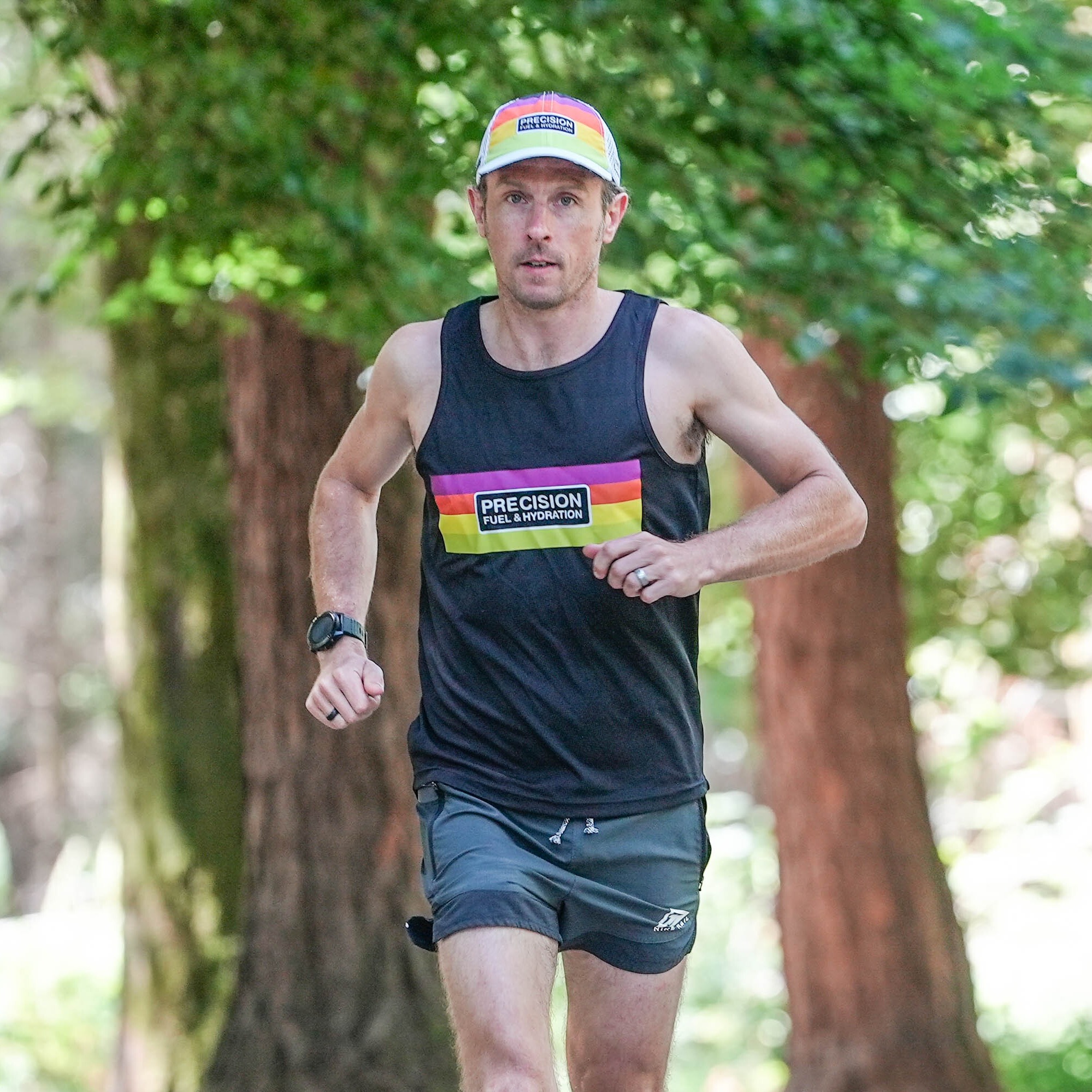
Andy Blow
Los Angeles Marathon

Andy's headline numbers
Andy's strategy
Fueling
Carbohydrate is the main fuel you burn when racing. Failing to fuel properly is a leading cause of underperformance in longer races.
Andy consumed ~390g of carbohydrate (that works out as ~5g of carb per kilogram of his bodyweight) the day before, and a further ~130g (~2g/kg) on race morning with the help of PF 30 Chews and PF Carb & Electrolyte Drink Mix. Given the scientific carb loading recommendations are ~8–12g/kg, he should look to increase his intake within 24 hours of the marathon, as this lower amount was likely insufficient to see meaningful increases in maximal glycogen storage. In-race he averaged ~101g of carb per hour, driven by two PF 90 Gels, two flasks of PF Carb & Electrolyte Drink Mix, and a second caffeine gel. Executing above the 90g/h threshold with a 9/10 rating of gut comfort is a strong result and reflects Andy's well-developed gut tolerance from many years of racing and gel testing.
Hydration
Taking on board an appropriate amount of fluid and sodium is essential to maintaining blood volume and supporting the cardiovascular effort needed to perform on race day.
Whilst the absolute amount of sodium and fluid consumed per hour is important, it’s critical to consider these in relation to each other. This is known as 'relative sodium concentration' and it’s expressed in milligrams per litre (mg/L). How much sodium you’re taking in per litre of fluid is more important than the absolute amount taken in per hour.
Sweat sodium concentration (mg/L) is largely genetically determined and remains relatively stable. Knowing how salty your sweat is enables you to replace a good proportion of your sweat losses, which can range from 200-2,000mg/L.
Given Andy’s losses are Very High (1,850mg/L), nailing his hydration strategy remains important, even when it’s Mild.
Learn moreAs founder of Precision Fuel & Hydration, Andy has a breadth of knowledge on his sweat sodium and fluid losses, but being a salty and heavy sweater can still be hard to manage as temperatures rise. He made the smart decision to preload with PH 1500 on race morning and consume two 500ml soft flasks containing PF Carb & Electrolyte Drink Mix, one 200ml flask of PH 1000 (Tablet) and some water from aid stations, totalling ~1.4L of fluid at a relative sodium concentration of ~868mg/L. At ~484ml/h though, his intake fell short of his ~1.43L/h sweat rate, leaving him 2.4kg lighter post-race. This 3.1% reduction in body weight is past the 2% threshold at which performance is thought to be negatively affected. This degree of dehydration would have driven plasma sodium concentration upward rather than generated a sodium deficit; the more significant physiological consequence was a meaningful reduction in blood volume which, alongside the physical demands of the closing kilometres, may have contributed to Andy’s muscle cramps. Increasing fluid intake is the priority for a heavy sweater like Andy in these conditions, swapping the smaller 200ml flask for a third 500ml flask, and taking Electrolyte Capsules alongside plain water would provide the volume and the sodium to support absorption and avoid dilution.
Caffeine
Beyond the Three Levers of Performance (carb, sodium and fluid), caffeine is one of only a few substances that is proven to improve performance for most endurance athletes as it can help stave off mental and physical fatigue.
Andy's race day caffeine intake came from two PF 30 Caffeine Gels – one taken 15 minutes before the start and one at approximately 15 miles in. Based on his bodyweight, alongside his morning black coffee, this places him close to the lower end of the 3–6mg/kg recommended range where meaningful endurance performance benefits have been demonstrated. The timing was well-structured, but given Andy's high tolerance as a regular caffeine user, the overall dose was still conservative. A higher total dose, for example by including another caffeine gel in the latter stages, may have provided a useful stimulus during the final 10km where things became a real grind.
How Andy hit his numbers
Here's everything that Andy ate and drank on the day...
Andy's weapons of choice
Final thoughts
Andy PF&H
PF&HAndy's full stats
Data Confidence?
There is good confidence in the accuracy of the data reported. An athlete feels that the numbers closely reflect what they consumed despite a couple of estimations which may carry some degree of error. The majority of what was consumed is recorded to a high level of specificity (most volumes are known through the use of bottles brands quantities flavours). The numbers are very plausible and align with previous data recordings (if an athlete has collected data previously).