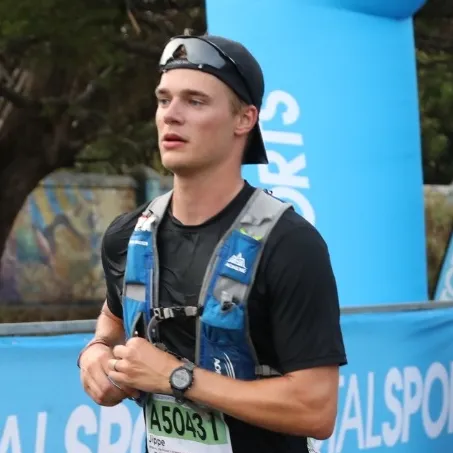
Jippe Lasschuijt
Precision Fuel & Hydration IRONMAN 70.3® World Championship

Jippe's headline numbers
Jippe's strategy
Fueling
Carbohydrate is the main fuel you burn when racing. Failing to fuel properly is a leading cause of underperformance in longer races.
Jippe targeted 120g of carbohydrate per hour on the bike and hit an impressive ~117g/h by combining PF 30 Gels with PF Carb & Electrolyte Drink Mix. This kind of high intake requires dedicated gut training, and Jippe's preparation paid off with consistent energy levels throughout the demanding climbs. The run, however, was tougher, and with just two gels across the half-marathon, his carb intake dropped to ~40g/h (66% drop off). For future races, carrying a Flow Flask with PF 300 Flow Gel could help him maintain a higher carb intake through the end without relying solely on aid stations and being limited in his fueling options.
Hydration
Taking on board an appropriate amount of fluid and sodium is essential to maintaining blood volume and supporting the cardiovascular effort needed to perform on race day.
Whilst the absolute amount of sodium and fluid consumed per hour is important, it’s critical to consider these in relation to each other. This is known as 'relative sodium concentration' and it’s expressed in milligrams per litre (mg/L). How much sodium you’re taking in per litre of fluid is more important than the absolute amount taken in per hour.
In the mild Marbella conditions (~21°C), Jippe's fluid intake of ~750ml/h on the bike was appropriate, helping him avoid GI distress while maintaining good hydration status. It also meant that he was self-sufficient enough to avoid aid stations and keep the pace high on the bike.
Jippe used PF Carb & Electrolyte Drink Mix to achieve a relative sodium concentration of 1000mg/L on the bike, which then dropped a bit on the run when relying on PH 1000 and water on-course. He was still able to average ~820mg/L overall, which is an excellent target sodium intake for those individuals without a sweat test, considering the average sweat sodium concentration we see across thousands of tests is a bit over ~900mg/L. The occasional quad cramps on the final climbs were likely in part due to muscle fatigue from the repeated climbing efforts instead of a hydration shortfall.
Caffeine
Beyond the Three Levers of Performance (carb, sodium and fluid), caffeine is one of only a few substances that is proven to improve performance for most endurance athletes as it can help stave off mental and physical fatigue.
Jippe kept his caffeine strategy simple: a PF 30 Caffeine Gel before the swim and another in T2. This timing meant the ergogenic effects of that second dose would kick in during the second half of the run when fatigue was setting in. Since his total intake of ~2.7mg/kg was just below the guidelines, he could benefit from a third caffeine gel during the bike to receive the full effects.
How Jippe hit his numbers
Here's everything that Jippe ate and drank on the day...
Jippe's weapons of choice
Final thoughts
Jippe PF&H
PF&HJippe's full stats
Data Confidence?
There is an adequate level of accuracy in the data collected and the numbers reported. The athlete manages to recall what they ate and drank including most specifics (brands flavours quantities plausible estimations of volumes). However there are estimations made within the data which affect the overall confidence level in the data reported.