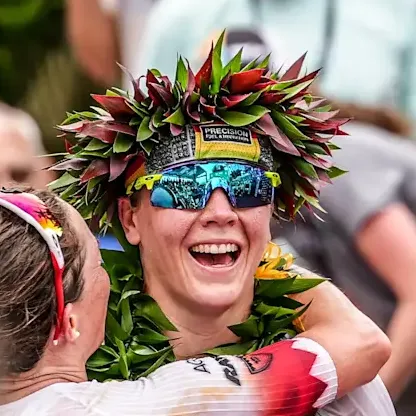
Solveig Løvseth


IRONMAN 70.3® Oceanside

Solveig's headline numbers
Solveig's strategy
Fueling
Carbohydrate is the main fuel you burn when racing. Failing to fuel properly is a leading cause of underperformance in longer races.
The reigning IRONMAN® World Champion opened her 2026 season with a fueling strategy built for success. After a solid pre-race breakfast of toast, rice and a PF 30 Chew three hours before the start, Solveig took her signature double hit of PF 30 Caffeine Gels in the final 30 minutes to spike blood glucose levels and deliver a caffeine dose heading into the water. On the bike, she used a two-bottle system; one litre bottle containing a prototype carbohydrate drink mix and another with half a PF 300 Flow Gel, each topped with two PH 1500 Tablets. Just like Jelle Geens used at the 70.3® World Championship, the prototype drink mix is a product Solveig has been testing in training as part of her preparation for a big year ahead and, combined with her go-to Flow Gel, it enabled her to take in ~147g of carb per hour on the bike. She then carried a 500ml soft flask of the same prototype mix out of T2, supplemented with two PF 30 Gels, to sustain ~133g/h through to the line. Her overall average of ~139g/h sits well above the standard recommendations but still just below her highest ever at the Precision Fuel and Hydration 70.3® World Championships in Marbella (141g/h) and just above her intake during her win at the IRONMAN® World Championship in Kona (132g/h) last year. Such a consistently high carb intake is a testament to the gut training she has put in ahead of this new season. With a solid GI comfort until the final gel, this was a well-executed, high-carb strategy that underpinned the fastest half-marathon of the day.
Hydration
Taking on board an appropriate amount of fluid and sodium is essential to maintaining blood volume and supporting the cardiovascular effort needed to perform on race day.
Whilst the absolute amount of sodium and fluid consumed per hour is important, it’s critical to consider these in relation to each other. This is known as 'relative sodium concentration' and it’s expressed in milligrams per litre (mg/L). How much sodium you’re taking in per litre of fluid is more important than the absolute amount taken in per hour.
Sweat sodium concentration (mg/L) is largely genetically determined and remains relatively stable. Knowing how salty your sweat is enables you to replace a good proportion of your sweat losses, which can range from 200-2,000mg/L.
Whilst Solveig’s losses are on the moderate side, getting her hydration strategy right is still important if she wants to perform at her best.
Learn moreSolveig's hydration strategy was defined by a deliberate front-loading of sodium on the bike and a lighter approach from T2 onwards. On the bike, each of her two 1L bottles contained two PH 1500 Tablets, bringing the relative sodium concentration to ~1500mg/L, comfortably above her measured sweat sodium concentration. This proactive approach allowed her to build a sodium surplus during the bike to draw from during the run. During the half-marathon, she took sips of on-course PH 1000 alongside water from aid stations, ultimately bringing her run relative sodium concentration down to ~237mg/L. She also applied water dousing from the very first aid station to manage heat stress in the warmer-than-expected conditions, which was a proactive approach to cooling. With an average fluid intake of ~875ml/h on the bike and ~762ml/h on the run, she maintained hydration well. For warmer 70.3®’s and full-distance races in the future, bringing along Electrolyte Capsules or including PH 1500 in her soft flask would narrow the gap between her run sodium intake and her sweat sodium losses, which would be helpful in more stressful conditions when overall sweat fluid and sodium losses are higher.
Caffeine
Beyond the Three Levers of Performance (carb, sodium and fluid), caffeine is one of only a few substances that is proven to improve performance for most endurance athletes as it can help stave off mental and physical fatigue.
Solveig's caffeine strategy is distinctive and calculated. She took two PF 30 Caffeine Gels approximately 30 minutes before the swim and an additional two on the bike with around 20km to go, giving her a total of 400mg (~5.6mg/kg) across the race. This double-dose approach is designed to create two peaks in blood caffeine concentration: one at the start of the bike, and a second timed to coincide with the start of the run. Given that caffeine typically peaks in the bloodstream ~45 minutes after ingestion and has a half-life of ~4-5 hours, this timing meant Solveig was likely at the recommended 3-6mg/kg circulating levels throughout the bike and run, supporting her blistering fastest half marathon split of the day.
How Solveig hit her numbers
Here's everything that Solveig ate and drank on the day...
Solveig's weapons of choice
Final thoughts
Solveig PF&H
PF&HSolveig's full stats
Data Confidence?
There is good confidence in the accuracy of the data reported. An athlete feels that the numbers closely reflect what they consumed despite a couple of estimations which may carry some degree of error. The majority of what was consumed is recorded to a high level of specificity (most volumes are known through the use of bottles brands quantities flavours). The numbers are very plausible and align with previous data recordings (if an athlete has collected data previously).